



It's scandal after scandal which aggravates the Bush Administration's last golden hours and miniscules their grandiose attempt at leaving behind a legacy of conservative imprint in all branches of government. If we go back almost six years ago we have a list for your consideration: the Terri Schiavo case, the US Supreme Court nominee fiasco, the Iraq invasion, the mismanagement of the war on terror, the poor accountability of funds in the first year of the war, the suspicious contracting to big corporations, Hurricane Katrina, the 'remake' of his staff, the ousting of a CIA covert agent, the firing of US prosecutors, and the list goes on. But historians will ultimately judge Bush's presidency based on his leadership through two tragedies — the Sept. 11, 2001 attacks and Hurricane Katrina, plus a conflict of his own design: The war in Iraq.
Unfortunately, Americans have a very poor memory, and when the time comes, Bush junior will be remembered with a condenscending grim and we will all struggle to remember the shame and incompetence which brought this country to the back of the line. Just like Bush seems to have lost the capacity of connecting with an anxious public (his ratings have been in the 30's% for many years now), so will we have lost the capacity of connecting his failures with his blundering presidency.
Showing posts with label bush. Show all posts
Showing posts with label bush. Show all posts
May 02, 2007


March 30, 2007
Ahmadinejad and Bush
I know, I know, it does not sound very respectful but consider the facts:
Ahmadinejad's approval ratings in Iran: possibly 40%
Bush's approval rating at home: 31%
Admadinejad ran for President on a campain focused on corruption and oil wealth for the poor.
Bush ran for President on a platform for restoring traditional values and compassionate politics. Both ran like reformists and ended up as neo-conservatists and hypermoralists.
Ahmadinejad is the first nonmullah to be Iran's President since 1981.
Bush is the first conservative republican to be President since 1984 (last one was Reagan).
Did I mention the fact that the legislature in both countries has continously rejected appointees by these two leaders? For example, the Majlis or Parliament has rejected several Ahmadinejad's Cabinet appointments, just like Congress has oppossed several of Bush's appointees.
Both leaders use military, political and religious rethoric to lure supporters into their webs. They are both hated by elites and moderates in their respective countries, and poor domestic policies haunt them while international policies have yet to yield positive results.
Ahmadinejad has frequently made allusions of his connection to a divine order, just like Bush has made comments of speaking to God and being in constant communication with Him.
Just like the Bush administration was forced to implement policies of the Iraq Study Group, so is Ahmadinejad being pressured to adopt some of the resolutions set forth by the UN Security Council in order to avoid further sanctions that will undermine Iran's economic growth.
So there you have it. Sometimes simililarities can be a siginifact divider in a already strained relationship such as this one. The US is waiting for Iranian moderate forces to prevail in this showdown of power, while Iran's Ahmadinejad is banking on the same exact thing.
Good luck.
Ahmadinejad's approval ratings in Iran: possibly 40%
Bush's approval rating at home: 31%
Admadinejad ran for President on a campain focused on corruption and oil wealth for the poor.
Bush ran for President on a platform for restoring traditional values and compassionate politics. Both ran like reformists and ended up as neo-conservatists and hypermoralists.
Ahmadinejad is the first nonmullah to be Iran's President since 1981.
Bush is the first conservative republican to be President since 1984 (last one was Reagan).
Did I mention the fact that the legislature in both countries has continously rejected appointees by these two leaders? For example, the Majlis or Parliament has rejected several Ahmadinejad's Cabinet appointments, just like Congress has oppossed several of Bush's appointees.
Both leaders use military, political and religious rethoric to lure supporters into their webs. They are both hated by elites and moderates in their respective countries, and poor domestic policies haunt them while international policies have yet to yield positive results.
Ahmadinejad has frequently made allusions of his connection to a divine order, just like Bush has made comments of speaking to God and being in constant communication with Him.
Just like the Bush administration was forced to implement policies of the Iraq Study Group, so is Ahmadinejad being pressured to adopt some of the resolutions set forth by the UN Security Council in order to avoid further sanctions that will undermine Iran's economic growth.
So there you have it. Sometimes simililarities can be a siginifact divider in a already strained relationship such as this one. The US is waiting for Iranian moderate forces to prevail in this showdown of power, while Iran's Ahmadinejad is banking on the same exact thing.
Good luck.
March 13, 2007
Latin America: US involvement a decade too late....
So, Bush wraps up a 5-day tour in Latin America, but brings back nothing with him.
This tour has come too late at a moment when US diplomacy is at its weakest in decades, even in recent weeks of renewed diplomatic talks with countries in the Middle East and China, and only thanks to Rice, who has been eargely making the rounds, in a move to clear up and wash out the Bush Administration's lack of foreign diplomatic overtures.
Latin America, with all its complexities and problems, seems to be hanging tough, as they have waited years to see trade agreements finalized, economic aid disembursed, and political commitments materialized. South America has for now found their guy in Venezuela's Chavez, who is more than willing to fill in the vacuum and which has plenty of cash and free advice to give.
This is exactly the danger and the frivolity of territorial politics, and the Bush Administration never seemed to capitalize on it. As Lebanon fell to Hizballah when Syria pulled out, everyone seemed too busy with the 'terrorists' and insurgents in Afghanistan and Iraq, including the US.
Now, it is too late for US deals and cheap talk; China has moved in to provide trade and aid and Chavez has continued to engulf South America and Central America with his populist rethoric. Today, Venuezuela's political and economic influence in the region is proportioned to Russia's oil supply to China's economy. China is always shopping for oil suppliers and has found a loyal one in Venezuela, which only helps to fuel Chavez's regional agenda.
I say this to Bush: go back to your drawing board and come up with a new set of economic and political policies that can efficiently compete with Chavez's own.
This tour has come too late at a moment when US diplomacy is at its weakest in decades, even in recent weeks of renewed diplomatic talks with countries in the Middle East and China, and only thanks to Rice, who has been eargely making the rounds, in a move to clear up and wash out the Bush Administration's lack of foreign diplomatic overtures.
Latin America, with all its complexities and problems, seems to be hanging tough, as they have waited years to see trade agreements finalized, economic aid disembursed, and political commitments materialized. South America has for now found their guy in Venezuela's Chavez, who is more than willing to fill in the vacuum and which has plenty of cash and free advice to give.
This is exactly the danger and the frivolity of territorial politics, and the Bush Administration never seemed to capitalize on it. As Lebanon fell to Hizballah when Syria pulled out, everyone seemed too busy with the 'terrorists' and insurgents in Afghanistan and Iraq, including the US.
Now, it is too late for US deals and cheap talk; China has moved in to provide trade and aid and Chavez has continued to engulf South America and Central America with his populist rethoric. Today, Venuezuela's political and economic influence in the region is proportioned to Russia's oil supply to China's economy. China is always shopping for oil suppliers and has found a loyal one in Venezuela, which only helps to fuel Chavez's regional agenda.
I say this to Bush: go back to your drawing board and come up with a new set of economic and political policies that can efficiently compete with Chavez's own.
January 22, 2007
How US Incompentence has created a civil war
It's been almost 4 years since the US invansion, and the Bush Administration has told us many incompetent lies about why we are still in Iraq. The excuses sounded so believable at the time (at least to Bush supporters): "we are fighting there so we don't have to fight them here",
" Saddan Hussein's trial we'll move Iraq forward", "national elections will free Iraquis", etc. Not even the capture of the No. 2 Al-Qaeda guy has yielded positive results. We are in a mess. A mess, nonetheless created by the same Administration that has vowed that this war is still winneable.
The truth is that the US is fighting a war on terror and the Iraquis are fighting a civil war. How can the US expect the Iraqui government to actually remedy the situation when the situation is not emendable by this Iraqui government. Iraq is so divided and the situation is so stark that the Kurds have been called in to manage troops deployments and to help secure Shiite dominated areas.
Even the manner in which Saddam's execution has been reverbated simply shows the state of affairs in Iraq's civil war-torn society.
The first consideration for the Bush team should have been the fact that the expectations for the Iraqui government to disarm militias were not realistic. The present Shiite administration is hanging on a threat, their leverage with the ongoing conflict is poor and their motives are unclear.
And now a surge of 21,000 troops has been called for by Bush. But the truth is logistically, this is a poor number, because even if Badghad shows signs of relative calm, other cities or towns will pick up the tab.
More poor policies ahead... will keep you posted.
" Saddan Hussein's trial we'll move Iraq forward", "national elections will free Iraquis", etc. Not even the capture of the No. 2 Al-Qaeda guy has yielded positive results. We are in a mess. A mess, nonetheless created by the same Administration that has vowed that this war is still winneable.
The truth is that the US is fighting a war on terror and the Iraquis are fighting a civil war. How can the US expect the Iraqui government to actually remedy the situation when the situation is not emendable by this Iraqui government. Iraq is so divided and the situation is so stark that the Kurds have been called in to manage troops deployments and to help secure Shiite dominated areas.
Even the manner in which Saddam's execution has been reverbated simply shows the state of affairs in Iraq's civil war-torn society.
The first consideration for the Bush team should have been the fact that the expectations for the Iraqui government to disarm militias were not realistic. The present Shiite administration is hanging on a threat, their leverage with the ongoing conflict is poor and their motives are unclear.
And now a surge of 21,000 troops has been called for by Bush. But the truth is logistically, this is a poor number, because even if Badghad shows signs of relative calm, other cities or towns will pick up the tab.
More poor policies ahead... will keep you posted.
June 16, 2006
The unrecognizable face of the office of the US Presidency
A lot has changed since January 2001 when the US presidency was assumed by George W. Bush. It is truly a privilege to witness the transfer of government in this solemn nation that prides itself in the democratic republic it was founded upon. Only a few nations in the world can experience this truly remarkable sight: the transfer of power in a transparent, democratic way. Hurray!
However, not everything is like it seems and this great nation of ours has seen an unprecedented use of executive powers that go well beyond the established Constitutional ones.
Since taken power in January 2001, President Bush has expanded presidential authority over this land without been challenged or denied. It has taken 5 ½ years for the other equal branches of government: Congress and the Courts to begin to push back against this great trespassing of government authority. In fact, Bush’s executive branch has seen the greatest expansion of presidential powers in a generation or more. (So much for limited government, you know that well-known Republican slogan).
Anyway going back to the issue, the most striking scenario has just been framed in regards to these powers. Congress has made an outcry of the FBI’s recent raid of the office of a congressman because it was not properly briefed about it. The Senate Intelligence Committee is demanding fuller briefings and copies of warrants submitted prior to the any search. Hah! I see, when it comes to members of Congress, then the Executive and the Courts are trespassing, but the American people have been complaining for over 5 years now. This is starting to look interesting, because it can actually give the Democrats a chance to win back the House or Senate this coming election.
Among the extended presidential powers the Bush White House has acquired are the following:
• Keep deliberations private/refusal to testify: White House Aides have refused to testify about the federal response to 9/11 and Katrina, arguing that it might discourage staffers from providing “untarnished advice” in the future.
• Restrict access to presidential papers: Bush signed an executive order in 2001 permitting former and current presidents and vice-presidents to restrict the release of their papers, which become public after 12 years of the end of an administration. (Is there anything else he is hiding from us?)
• Set aside laws and treaties: Ok this one is really annoying: Someone wrote a memo asserting that the president of the US (Bush) could violate federal laws and international treaties when he viewed it as necessary for the nation’s security. That someone was Attorney General Alberto Gonzalez.
• Interpret and curtail new laws: I was not aware he could actually interpret anything. Bush has issued more than 750 “signing statements” –more than all previous presidents combined - designed to state his own interpretation of the law and in some cases to claim a presidential prerogative not to enforce provisions that he says encroach on executive authority. For example the Torture Bill sponsored by Sen. McCain, which says that no torture will be performed by US military personnel, but Bush inserted a signing statement saying he holds the final say on the torture issue.
• Permit warrantless surveillance on domestic calls: Bush authorized the NSA to wiretap domestic phone calls of terror suspects without a court warrant if one of the participants is from abroad.
• Limit judicial oversight: This one really worries me and it should you too. The president claims the authority to designate US citizens “enemy combatants” who can be held indefinitely without charges. He has also asserted the right to hold terrorist suspects overseas and try them before special military commissions.
However, not everything is like it seems and this great nation of ours has seen an unprecedented use of executive powers that go well beyond the established Constitutional ones.
Since taken power in January 2001, President Bush has expanded presidential authority over this land without been challenged or denied. It has taken 5 ½ years for the other equal branches of government: Congress and the Courts to begin to push back against this great trespassing of government authority. In fact, Bush’s executive branch has seen the greatest expansion of presidential powers in a generation or more. (So much for limited government, you know that well-known Republican slogan).
Anyway going back to the issue, the most striking scenario has just been framed in regards to these powers. Congress has made an outcry of the FBI’s recent raid of the office of a congressman because it was not properly briefed about it. The Senate Intelligence Committee is demanding fuller briefings and copies of warrants submitted prior to the any search. Hah! I see, when it comes to members of Congress, then the Executive and the Courts are trespassing, but the American people have been complaining for over 5 years now. This is starting to look interesting, because it can actually give the Democrats a chance to win back the House or Senate this coming election.
Among the extended presidential powers the Bush White House has acquired are the following:
• Keep deliberations private/refusal to testify: White House Aides have refused to testify about the federal response to 9/11 and Katrina, arguing that it might discourage staffers from providing “untarnished advice” in the future.
• Restrict access to presidential papers: Bush signed an executive order in 2001 permitting former and current presidents and vice-presidents to restrict the release of their papers, which become public after 12 years of the end of an administration. (Is there anything else he is hiding from us?)
• Set aside laws and treaties: Ok this one is really annoying: Someone wrote a memo asserting that the president of the US (Bush) could violate federal laws and international treaties when he viewed it as necessary for the nation’s security. That someone was Attorney General Alberto Gonzalez.
• Interpret and curtail new laws: I was not aware he could actually interpret anything. Bush has issued more than 750 “signing statements” –more than all previous presidents combined - designed to state his own interpretation of the law and in some cases to claim a presidential prerogative not to enforce provisions that he says encroach on executive authority. For example the Torture Bill sponsored by Sen. McCain, which says that no torture will be performed by US military personnel, but Bush inserted a signing statement saying he holds the final say on the torture issue.
• Permit warrantless surveillance on domestic calls: Bush authorized the NSA to wiretap domestic phone calls of terror suspects without a court warrant if one of the participants is from abroad.
• Limit judicial oversight: This one really worries me and it should you too. The president claims the authority to designate US citizens “enemy combatants” who can be held indefinitely without charges. He has also asserted the right to hold terrorist suspects overseas and try them before special military commissions.
May 15, 2006
Foreign Policy Matters
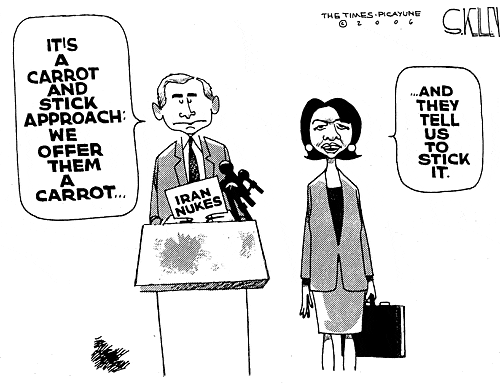
Far from being an expert in US foreign policy, I strongly believe this Administration not only suffers from a bipolar posture in regards to foreign policy making; but their faith-based dogmatic practices have clearly polluted the reflective mirror that gives shape to our foreign policy. It seems obvious that under this Administration the faith-based factor has come to play a critical role in the decisions influencing our foreign affairs. The time has come for the US to redesign their ideological thinking in regards to Middle East foreign policy.
You see for many years the U.S. has taken pride, or better yet, a misplaced gratification in being a rational, secular and unequivocal world leader in global affairs. Unfortunately, this is a pretense we can no longer export, let alone demand. It is true, the world has changed since 9/11 or at least some aspects of our tenure as the dominant world power have changed, but as dogmatic as many members of this Administration are when it comes to the tactical aspects of Middle Eastern political affairs, the urgent need to reestablish a coherent ideological criterion for dealing with the Middle East under a long term commitment instead of short term undertakings should not be considered an extra-curricular activity.
Since the start of the war on terror, our foreign policy has been the target of outspoken global criticism from incoherent and argumentatively short-sided to ineffective and contradictive. Even our position in the UN Security Council is sometimes counterproductive when Russia and China play the balancing act in many Mid East conflict negotiations. By refusing to establish a more accessible line of communication with Iran, and with the rest of the fundamentalist governments, which is long overdue and ultimately in our best interest, this Administration is single handedly diminishing the diplomatic strength and reputation of US and the important role it can play in the political world stage.
This diplomatic influence has already suffered many drawbacks. Under this Administration, the U.S. has been guilty of violating more international laws than our European counterparts fighting the war on terror. According to some observers - violations that have occurred at Abu Ghraib, Guantanamo Bay and Afghanistan, including the Eastern European countries acting as hosts for the CIA covert internment system that detains and possibly tortures terrorist suspects - we have overstepped the boundaries of the rule of law.
Three years after the U.S. invasion nobody raises the concern anymore that this might well be an illegal occupation under the tenets of international law as defined in the UN Charter. I can see now how Saddam might have been right about us, at least on legal grounds. Not only have we been accused of torture, unfair imprisonment and disrupting civil liberties under many international statutes including the UN Convention Against Torture, the International Covenant for Civil and Political Rights, and the UN Declaration of Human Rights; but what is more alarming is our reticence in admitting that as the number one world power, we continue to send mixed signals in regards to our actions and strategic interests only to naively expect that the Islamic states in the region follow our own failed guiding principles. Who are we fooling with our morality-heavy, faith-based policy making which has taken us deeper into a regional conflict that started as a game of parlor of political gains and has transcended into a conflict of political and ideological consequences?
Today many concerned Americans are struggling to understand the enormous price we are paying in lives, prosperity and national security in addition to our diminished diplomatic strength in the world community and the waves of resentment it has provoked even among our allies. The real consequence of our ignorant and misguided actions is the escalation of regional political unrest in an area plagued with religious and nationalistic sentiments that we are far from comprehending, unless we find a viable and realistic, long-term approach to Mid East foreign policy. Even more astounding is the direction our unilateral actions and extremist policies are taking us regarding the war on terror as evident in our negligence of multilateral commitments. Again, when it comes to foreign policy this Administration suffers from acute bipolarity and conflicting political principles. Let’s at least recognize that the cultural and religious framework we find ourselves in when it comes to the war on terror desperately needs rethinking.
Subscribe to:
Posts (Atom)


